Image
Blog
One of the greatest challenges graduate students and postdocs face is the sense of isolation. Amid heavy workloads, looming deadlines, and the constant pressure to perform, it’s easy to feel disconnected. Stepping away from work to socialize can often feel like an added item on your to-do list. Unfortunately, a lack of community doesn’t just impact your social life—it can also take a toll on your mental health and overall wellbeing. Ultimately, this can negatively affect your happiness and productivity. But where do you even begin to meet others who share common interests?
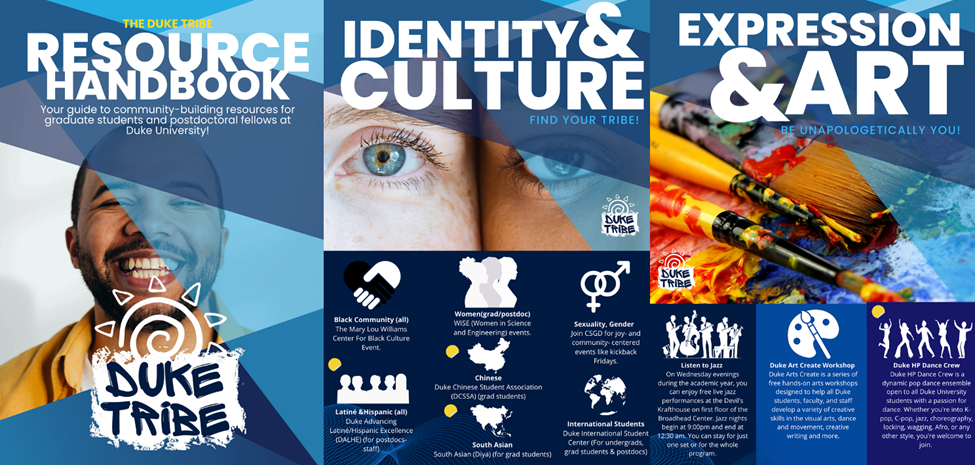
As an interdisciplinary team of graduate students and postdocs in the Emerging Leaders Institute (ELI), we were tasked to develop a project that would improve the campus experience for graduate students and postdocs. Our research led us to understand problems that affect our community. At Duke University, there are many wonderful resources designed to support graduate students and postdocs. However, these resources can be difficult and time-consuming to navigate, especially when you are already overwhelmed by work. That’s why we created Duke Tribe, a centralized, easy-to-use digital handbook designed to connect graduate students and postdocs with community-building resources.
Duke Tribe is a thoughtfully designed interactive toolkit built to help you find your community, explore your interests, and foster a strong sense of belonging at Duke.
Our ELI team spent weeks researching the vast landscape of Duke University’s online resources. We categorized every resource we found, eventually organizing them into nine key interest areas:

In addition to the categorization of resources, we also added visual icons to help users quickly identify important details, such as links to websites (unique icons), associated fees (green dollar sign), and specific group limitations (yellow sticker).

Duke Tribe isn’t just functional, it is also fun to use. We designed the handbook with vibrant visuals and engaging content to encourage exploration. Whether you’re looking for a running club, meditation group, or simply a place to unwind with art or music, there is a resource in Duke Tribe for everyone. To make sharing even easier, we included a QR code at the end of the handbook so you can pass it along to friends and colleagues in a quick scan.
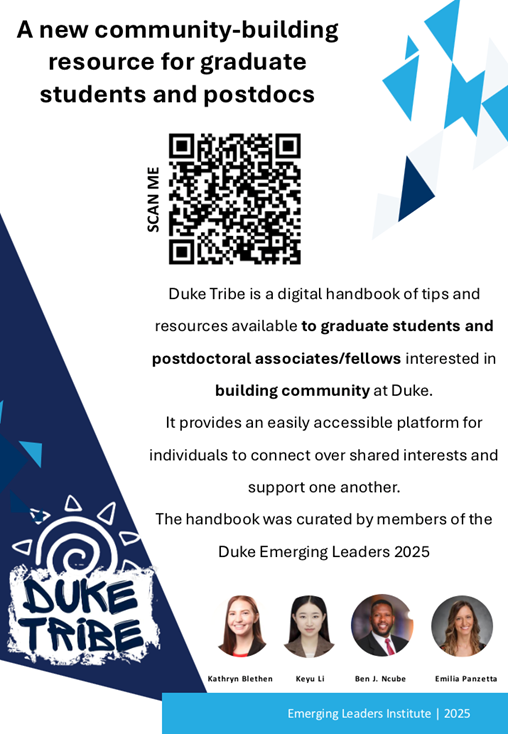
To further increase the visibility of our digital handbook, we designed a flyer and posted it in buildings across campus. This allows students and postdocs passing by to notice the flyer, become curious, and be encouraged to explore Duke Tribe. We also plan to promote the digital handbook at events, including new graduate student and postdoc orientations.
Ultimately, Duke Tribe is about belonging. We want to help graduate students and postdocs feel like they are a part of something bigger—a supportive, diverse community where they can thrive personally and professionally.
We envision Duke Tribe not just as a tool, but as a catalyst: a way to spark new friendships, encourage exploration, and make the Duke experience more enriching and interconnected. Whether someone is looking to join a club, discover a new passion, find peer support, or simply feel more connected to the campus community, we hope Duke Tribe offers an easy and welcoming starting point.
Our greatest hope is that Duke Tribe helps students and postdocs build relationships and communities that last far beyond their academic journey—connections that grow with them throughout their lives.
We want you to experience the power of connection right now. Take 60 seconds to reflect and ask yourself:
Now, open Duke Tribe and use the icons and categories to guide your search. Whether it's art, rock climbing, hiking meetups, or quiet meditation groups, your next meaningful connection might just be one click away.
Still not sure where to begin? Try our Duke Tribe Discovery Challenge:
We’d love to hear what you find. Tag us using #DukeTribe or #EmergingLeadersDuke.
Find your Tribe!
We are a team of graduate students and postdocs with diverse backgrounds who have experienced firsthand the overwhelming amount of information and activities available at Duke. Hearing from our community members about the deep need for belonging and the desire to find people with similar interests sparked the idea that eventually became Duke Tribe. Throughout our time at ELI, we not only focused on developing Duke Tribe, but also dedicated ourselves to self-exploration, learning about our personal leadership styles, and how to lead with our strengths while improving our soft skills. We believe these experiences will have a lasting impact on our careers and the communities we are a part of.

Postdoctoral Associate, Neurosurgery
Kathryn Blethen, Ph.D. is a postdoctoral associate in Dr. Grant’s laboratory in the Department of Neurosurgery. She completed her Ph.D. in pharmaceutical and pharmacological sciences at West Virginia University in 2023, where she received training in neuro-oncology, blood-brain barrier physiology, and pharmacokinetics. Her current research focuses on improving drug delivery strategies across the blood-brain barrier to increase efficacy for the treatment of brain tumors. As a woman from a rural small town in West Virginia, Dr. Blethen is passionate about inspiring students from rural communities to pursue higher education and research.

Ph.D. candidate, Electrical & Computer Engineering
Keyu Li is a sixth-year Ph.D. candidate in Dr. David Carlson's lab at Duke University's Electrical & Computer Engineering Department, specializing in machine learning. She holds a bachelor’s degree in computer science and technology from the Central University of Finance and Economics and was a visiting researcher at Harvard University. Passionate about entrepreneurship, she is completing the Duke Innovation & Entrepreneurship Certificate. Beyond academia, Keyu explores aesthetics, traditional Chinese medicine, nutrition science, and Eastern philosophies. A skilled dancer (Chinese traditional, jazz, K-pop), she also enjoys cooking, reading, writing, and quality time with her goldendoodle, Nomi.

M.S. student, Population Health Sciences
Ben Jammaine Ncube, LL.B., MBAis a multi-award-winning entrepreneur whose research focuses on global health policy, health equity, and health-seeking behaviors. At 23, Ben founded the first men's health clinic in Zimbabwe, which has impacted over 24,000 men. He has received 15+ awards for his work, including two healthcare Innovation awards from the President of Zimbabwe in 2024. Ben holds a bachelor of laws degree and two Global Master of Business Administration degrees in impact entrepreneurship, as well as 30+ certificates in community health, management, and leadership. As a first-year master’s student in population health sciences, Ben is exploring how big health data can inform the creation of male-inclusive interventions and adaptive healthcare facilities around the world.

Postdoctoral Associate, Integrative Immunobiology
Maria Emilia Panzetta, Ph.D. is a postdoctoral associate in the Department of Integrative Immunobiology. She completed her licentiate and Ph.D. in Chemistry at the National University of Cordoba (Argentina). She participated in international exchange programs in Spain and the U.S. and has teaching experience. Her current work focuses on the role of gut microbes in neurological disease. She hopes that her research can lead to the development of tools to improve disease progression in people with Amyotrophic Lateral Sclerosis. In her spare time, Emilia enjoys baking, traveling, taking photos, and spending time with friends and family.