Image

Blog
Rebecca Stafford is an experienced corporate finance executive and early-stage investor focused on climate tech and sustainability. She is the founder and managing partner at Hestia Venture Partners, which supports the low-carbon transition by investing in companies developing innovative solutions and in real estate assets positioned for targeted retrofit and renovation. Previously, Rebecca held senior leadership roles in real estate investment and institutional asset management, including as managing director and CFO/COO at Strada Investment Group. She holds a master’s degree in economics from Duke University and a bachelor’s in accounting from the University at Albany.
I have worked in finance my whole career, both before and after coming to Duke. I consider myself a corporate finance generalist in many ways, with a focus on investment management. Personally, I also have a passion for figuring out how technology can help us with the problem of climate change.
After earning my undergraduate degree in accounting and finance, I spent several years working in management consulting. While I found the work exciting, the lifestyle of constant travel wasn’t for me. Wanting a new challenge, I joined Banco Santiago in Santiago, Chile, and worked under a renowned Chilean economist. He was a strong mentor, and the work opened my eyes to the real-world impact of fiscal and monetary policy, especially in a smaller economy like Chile’s, where changes played out quickly and in visible ways.
To be honest, I hadn’t enjoyed economics much as an undergrad, but this hands-on exposure completely changed my perspective. It made me realize I didn’t want an MBA, but rather a degree in applied economics. That clarity led me to Duke, whose master's program was a perfect fit.
At Duke, I developed a dual focus: one on development economics and the role of financial systems, and the other on investment management and portfolio theory. I took cross-listed courses at the Fuqua School of Business with professors like Campbell R. Harvey and David A. Hsieh, which contributed to my training in finance.
I was torn between two paths: one in development economics, which is working for institutions like the Fed [Federal Reserve], the IMF [International Monetary Fund], or NGOs [non-governmental organizations], and another in investment management, which aligned more closely with my prior experience in finance. After graduation, I moved back to New York with my husband and chose a hedge fund role over an NGO, partly due to location and also because of my passion for portfolio theory. A year later, we relocated to the Bay Area, and I found myself facing a similar choice again: this time between the regional Federal Reserve and a real estate economics consulting firm. I chose the latter, which turned out to be a great blend of what I enjoyed—global macroeconomic analysis paired with portfolio optimization for institutional investors.
Looking back, I didn’t necessarily plan to return to the corporate finance path, but the opportunities I took allowed me to integrate the different skillsets I developed, which has been a fulfilling combination.
My career has taken different directions over time, but looking back, each transition felt like a logical progression. After moving to the Bay Area, I took a role in real estate economics. From there, I joined the investment office at the University of California, where I was uniquely positioned to manage both the hedge fund and real estate portfolios, a perfect intersection of my prior experience. I then moved into real estate private equity, which gave me more hands-on exposure to specific projects, though it leaned more toward micro-level decisions.
After years in private equity, I reached a point when I felt ready for a change. Around the same time, I began reflecting more seriously on my long-standing interest in sustainable building technologies. While I had explored this area in institutional settings, I often ran into limitations around fiduciary duty that made deeper implementation difficult. With growing experience, including volunteer work with the U.S. Green Building Council, and financial flexibility, I decided to leave and start working independently. Today, I focus on small-scale real estate investments and emerging climate technologies, also known as PropTech, where I can fully align impact with investment.
I now run a relatively small investment platform focused on technology startups and smaller real estate properties with potential for sustainable transformation. It’s very different from my past roles at large institutions where I had more capital and more market influence. But now I have greater flexibility to make decisions based on my own judgment and values.
For example, I’ve recently invested in a few fusion energy startups. These are long-shot, high-risk investments that would be very hard to push through in a traditional institutional setting. But in my current setup, I collaborate with a small syndicate of partners, some of whom are physicists, and together we can evaluate and support these opportunities. Additionally, I currently own an ag-tech site that is leased to a startup developing higher-protein, lower-water using higher-yield chickpea varieties. I am also exploring a modular agrivoltaic system on the same property. These are exactly the kinds of projects I couldn’t have done before, and I feel lucky to be able to pursue them now.
My interest in sustainability goes way back. My mother, a zoologist, was deeply environmentally conscious, far ahead of her time. Growing up, she had us living in a very eco-conscious way. While I didn’t always appreciate it at the time, my perspective changed once I entered the real estate world and joined the U.S. Green Building Council. I began learning not just how to finance buildings, but how to improve their impact on health and the environment.
I’ve come to really appreciate the balance I have now. With my kids now approaching college age, I have far more freedom than I did when they were younger. Compared to my previous roles in more traditional institutions, running my own platform allows for a great deal of flexibility. I can decide how much or how little I want to take on in a given week. Some days still feel intense—there are times I’ll work long hours just to push through a set of projects—but the difference now is that it’s by choice.
I know it’s probably a challenging time to graduate, for there’s a lot of uncertainty in the world. However, you’re graduating with cutting-edge quantitative skills such as coding and AI tools, which many of us have to go seek out or teach ourselves. That’s a real strength and one that employers are actively seeking.
Additionally, lean into the Duke network. You have access to an incredible alumni base, so don’t be shy about making those connections. Even if someone doesn’t have a job to offer, they may be able to provide guidance or introductions that make all the difference. Especially in uncertain times, this kind of community support is invaluable.
I truly loved the energy of the campus, especially the school spirit and the vibrancy of student life. I found it inspiring to witness, though I didn’t participate much myself. Now, as my own children begin thinking about college, I’ve come to appreciate even more the appeal of a university environment that combines strong academics with a lively, spirited campus culture.
M.A. student, Economics
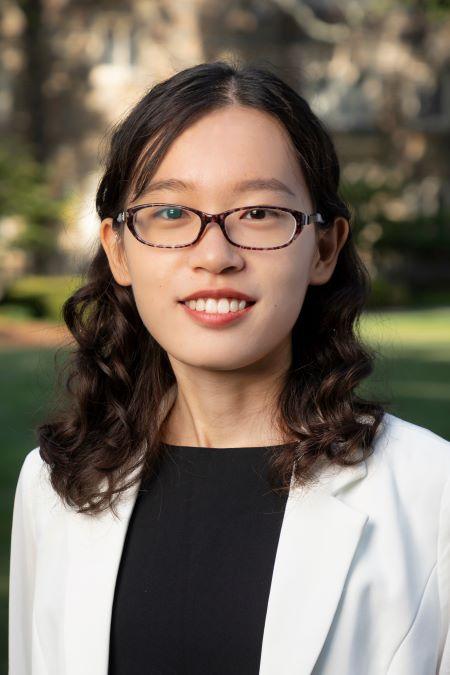
Tianai Wang is a master’s student in the Department of Economics at Duke University. She is interested in investment research with a focus on company strategy and industry dynamics, particularly in sectors such as energy and healthcare. Outside of class, Tianai enjoys climbing, backpacking, and movies.