Image

Blog
Lindsay Ballengee, P.T., D.P.T., Ph.D. is a physical therapist and implementation researcher who has built her career at the intersection of clinical practice, education, and research particularly in the areas of pain management and implementation science. She received her B.A. in political science from The Ohio State University, her Doctor of Physical Therapy from Duke University in 2011 and her Ph.D. in Population Health Sciences from Duke in 2024. Currently, she’s a postdoc at the Duke Clinical Research institute (DCRI) working on implementation of non-pharmacologic pain treatments.
I graduated in 2011 from the Doctor of Physical Therapy program and was a practicing physical therapist before coming back to Duke in 2017 to do the Faculty Development Residency in the Duke DPT program. After that residency, I returned to the Department of Veterans Affairs and completed a fellowship in quality improvement and implementation science. It was during the residency and fellowship that I realized I really liked research and decided to apply for the Ph.D. in population health sciences at Duke. Their program allowed me to be at the intersection of pain research and implementation science. As a clinician, I’d spent a lot of time with patients who had chronic pain and felt like we weren't doing a very good job of getting evidence-based treatments to the people who needed them and was very interested in learning more about implementation science to help bridge this gap. That gap is what I've been focusing on both in the Ph.D. and now as a postdoc.
I knew that I wanted to do research in some capacity but didn't really know what that looked like. The more I learned about implementation science, the more it became clear that I wanted to pursue an embedded research position where I could use my background in quality improvement and implementation science to help with front-line projects on the health system side and also contribute to the academic research side.
I'm at the Duke Clinical Research Institute as a postdoctoral research scholar and have had the opportunity to keep working with many of the same people that I worked with during my Ph.D. studies. It’s been interesting to transition from the student role to taking more ownership over projects. It's been great to be able to stay at Duke because I feel like I'm not starting from scratch—I still have that incredible Duke network and relationships to keep building from.
My favorite thing about my current role is that I'm getting to apply implementation science to my work. The theories and concepts that I learned about during the Ph.D. are helping me write grant applications and proposals, but I'm also getting to use that knowledge on the health system side in a very practical way. It's been interesting to learn how to take very theoretical concepts and apply them to real-world health system issues.
Meira Epplein has a wonderful grant-writing class. She taught us to be super specific in our writing and emphasized how important it is to have a story and a thread for readers to follow. Whether I'm applying for a grant, writing a manuscript, or just writing something informational, I use those skills every single day. Dr. Epplein has such a wonderful manner and way of teaching that class. She taught us that writing is like a muscle that you have to work each day.
I’m working on several projects that are investigating different care pathways for pain. In particular, we’re focusing on how to best implement non-pharmacologic pain treatments and how to break down barriers for patients to get the right care at the right time.
One of my mentors has emphasized that it’s super important to figure out what makes you excited to get out of bed in the morning. Figure out what really drives you and what you’re willing to work hard for. Don’t go after titles just because they sound impressive. Stick with what aligns with your values, and you’ll find the right people, the right work, and the right place to grow.
Find your purpose, something meaningful that can guide you through stressful times and uncertainty and let that be your compass.
Maybe some more tangible advice is to find a practical time management strategy. One of the most helpful things I’ve learned is to block out time on your calendar for specific tasks, not just meetings. Schedule focused work (i.e. “write from 10–11” or “analyze data from 2–3”) so that big goals become actionable. It keeps you accountable, gives you a sense of progress, and helps prevent tasks from falling through the cracks.
My two young kids have actually helped me find balance by forcing me to manage my time well. I knew that once I got home, I wasn’t doing any more schoolwork because that was family time. Also, I’m not a night owl, so I had to get my work done during the day. My kids weren’t a distraction—they were my grounding. In high-stress moments, especially during the Ph.D., they reminded me that it wasn’t that serious. Whatever academic challenge I was facing, it didn’t define my whole world. While it can be hard to juggle family and work, for me, it was also a huge source of perspective and stress relief.
Lots of my time outside of work revolves around my kids. They’re into sports, so I spend a lot of time at freezing hockey rinks and sweltering lacrosse fields. We also love going to amusement parks, especially Disney, which has become a fun escape and something we really look forward to as a family.
My favorite memory is when I defended my Ph.D. dissertation in July 2024. After I finished my presentation, my committee held the meeting to determine whether I had passed. When they called me back into the room, I saw my Dad, my husband, my son Milo, as well as my two committee chairs, Leah Zullig and Steven Z. George, all standing next to each other in a sort of surreal moment. I’ve been working with Dr. George since 2017 and he has helped me navigate different fellowships, the Ph.D. program, and now my postdoc. I saw that group standing there, my dad had tears in his eyes, and my mentor got this huge smile on his face, before saying, “Congratulations, Dr. Ballengee, you have passed.” It was such a special moment to have my family and my mentors there while realizing that all the sacrifices had paid off. That moment will be ingrained in my memory for a long time.
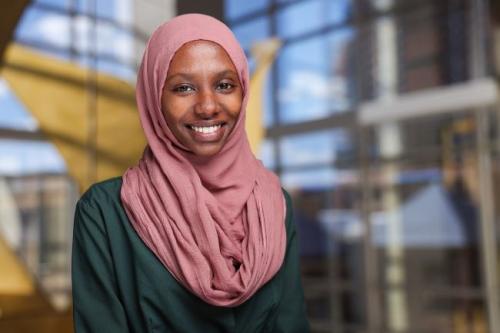
Ph.D. student, Population Health Sciences
Sahar Shibeika is a population health sciences student at Duke University with a pharmacy degree and M.S. of pharmaceutical sciences from Sudan. She is passionate about providing patient-centered care, improving quality of life, and addressing health disparities to enhance patient outcomes. Her research interests include aging, dementia, cardiovascular diseases, caregiving, and implementation science.