Image
Blog
Julie Neubauerreceived her Ph.D. in pharmacology from Duke University after earning her B.S. in biochemistry and cell biology from Rice University, then pursued a postdoc at Case Western Reserve University. She began her industry career at IQVIA as a clinical trial proposal developer before moving to a product manager role. She continued in a product manager role at LiveSwitch and then at Lumos Labs. Beyond her industry experience, she was an adjunct professor at Cleveland State University and Cuyahoga Community College. She has also served as an editor at American Journal Experts to ensure scientific concepts and data are presented clearly and concisely. Currently, Dr. Neubauer is an associate director of product management at BeOne Medicines.
When I was at Duke, I knew that I wasn’t headed to academia. I did a lot at Duke to make sure that I was exploring other options. My goal was industry, but I participated in the Preparing Future Faculty program. I didn’t really think I was going into teaching, but I wanted to have the resources and the experience.
I did a lot of networking; none of it led directly to where I am currently, but it gave me a broader perspective of what was out there. I ended up moving to Cleveland, Ohio. There is no biotech industry there. I did a postdoc and taught biochemistry at Cleveland State University, and the Preparing Future Faculty program at Duke was useful in getting me there. I stayed at my postdoc for a year and a half. For my postdoc, I was working on understanding the active site of a virus that was analogous to rabies, but it was far away from ever helping anybody. I felt that I wasn’t close enough to healthcare.
I started to explore how to create near-term meaningful impact. I got a remote job at IQVIA, a clinical research organization, where they run clinical trials for pharma companies. In this position, I brought people who had expertise in different aspects of the trial together and then wrote up a proposal about how IQVIA would run the trial and how much it would cost. I was open to opportunities as they came my way. I became the resource manager, working with people to figure out what was needed, who was available, and to track their current and future capacity. I built Excel templates, but they could break easily. I found a better way to do this was to get into automation, and that landed me a job that is called a product manager. I didn’t know it existed. A product manager is the person who translates between people who need a solution to a problem and people who can create that solution.
From there I went to a totally different company. Here, we were working on web real-time communication. Nothing to do with science. It was my experiment to see how much I wanted to be in the biological sciences, or could I be happy coming up with solutions to other problems. After that I knew I wanted to be in a product manager role in health care. At that point, I had a really good story: I had a Ph.D., I had the clinical trial experience, I did my tech pivot, and now I am really focused on the health component to software development. So, I ended up at Lumos Labs, where I was the product manager at their medical department. Unfortunately, clinical trials are expensive. Lumos ran out of money, so they had to shut their medical division. My last job search ended up at BeOne. They run their own clinical trials, and my role is handling their internal resourcing product for them: it’s designed to figure out how many people they need who are medical writers or clinical research associates or medical advisors for the whole pipeline of studies that they are going to run, so that they have the resources to complete the studies.
A product manager translates between people who need a solution to a problem and people who can create that solution. Then they figure out how much the solution helps and how much people are willing to pay for it to understand how it could create benefits. Product managers decide which of the requirements is the priority. Overall, you are managing priorities to make sure you are delivering value.
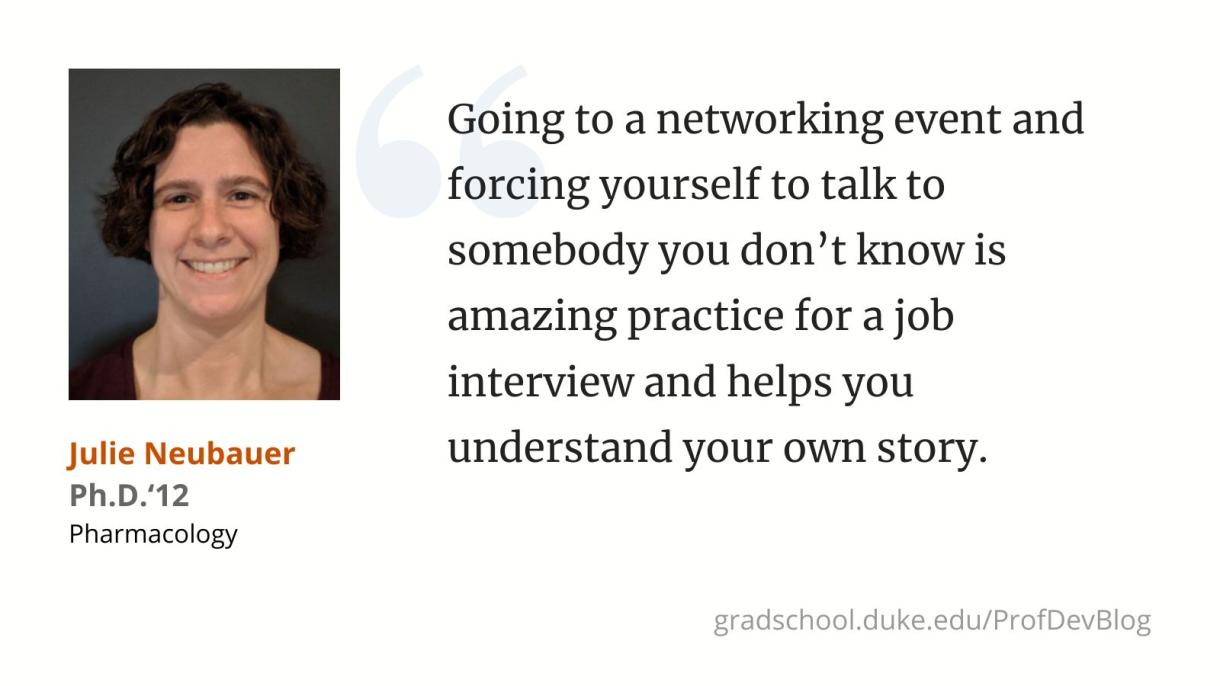
I really worked hard to say yes to everything. There are a number of networking events in the Triangle area. Going to a networking event and forcing yourself to talk to somebody you don’t know is amazing practice for a job interview and helps you understand your own story. When you are talking to that stranger and their eyes glaze over, you know that it wasn’t a compelling story, and you need to work on it. And it’s so low stakes; you probably are never going to see them again. You have the opportunity to craft that elevator pitch. Make time for it.
Being able to have an elevator pitch for yourself is huge. When I went to conferences, I was able to deliver my elevator pitch and ask to connect on LinkedIn. When I was laid off the last time, I had so many people in my network. I could ping them when I was looking for a job, and I had people make introductions. So being able to be that personable professional is important.
If you can get through grad school, you can navigate anything. People talk about high school being a microcosm of the world. I think that grad school can use the same analogy for professional life, because you are going to have experiments that don’t work. You are going to have experiments that require so much tedious work. You still get them done and move on to the next experiments. I think you develop a recognition that this is a season, and I think this attitude is helpful in navigating uncertainty.
You should be seeking out opportunities to learn new things. People who are interested in continuously learning are rare in the world. I spent a fair amount of time thinking about whether going to grad school was worth it. Then someone mentioned that I understand what’s going on ten times faster than anybody else because I am more experienced in synthesizing different pieces of data. This is my habit; this is my profession. Remember that you don’t need to be an expert in a thing; you need to be an expert at learning how to do a thing. And that is exactly what graduate school teaches you how to do.

Ph.D. student, Molecular Genetics and Microbiology
Mansi Patel is a Ph.D. student working on cancer research in the lab of Dr. Everardo Macias. Her research focuses on identifying new drug targets for prostate cancer. In her free time, she enjoys making paintings, making henna tattoos, and taking nature walks.