Image
Blog
Gilbert Nolet is a retired geoscientist with over three decades of experience in the oil industry, primarily with ExxonMobil. Nolet's passion for geology started early in his academic career, earning a degree in the field from the University of South Carolina before pursuing a master's degree from Duke University. At Duke, Mr. Nolet's research focused on paleoecology and microfossils, specifically benthic foraminifera. After graduating in 1987, he transitioned into the oil industry, working for ExxonMobil for 33.5 years. During his time there, he held various positions, including biostratigrapher and general geologist, and he became a subject matter expert in resource assessment later in his career. Mr. Nolet's expertise in geology and paleontology proved valuable in his role as a resource size evaluator, where he assessed the potential of new oil discoveries and prospects to be drilled. Since retiring in 2021, Mr. Nolet has relocated to Weaverville, NC, where he enjoys the mountain scenery and proximity to family. He remains connected to his profession through his LinkedIn profile, a monthly gathering of retired geoscientists leaving near Asheville, and occasional conversations with former colleagues. Mr. Nolet's career path exemplifies the diverse opportunities available to geoscientists, both within academia and the broader industry.
I'm originally from Montreal and earned my undergraduate geology degree at the University of South Carolina. I came to Duke for my master's, initially hoping to work with Dr. Orrin Pilkey. However, I ended up focusing on microfossils and paleoecology with Dr. Bruce Corliss, which led to a thesis on the eastern Mediterranean.
My academic background in paleoecology and microfossils provided me with a solid foundation in geological concepts and research methodologies.
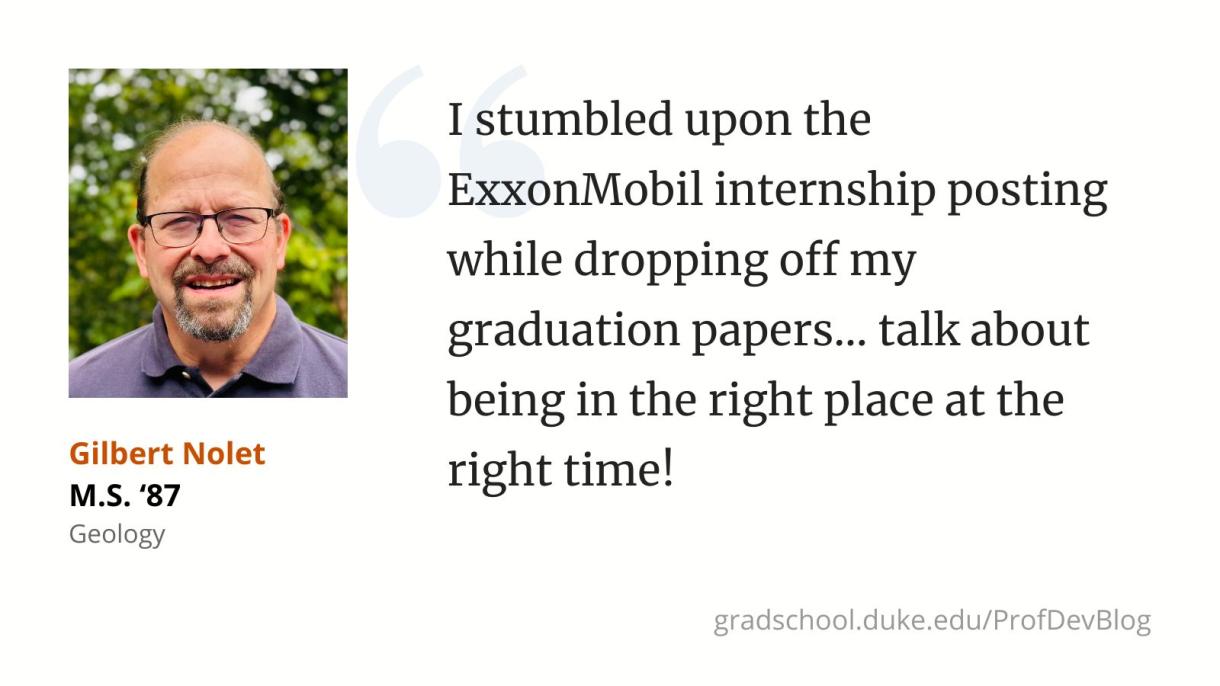
However, upon entering the oil industry, I realized that my specialization in paleontology and biostratigraphy wasn't always seen as directly relevant to industry needs. Despite this, my broad geological knowledge and willingness to adapt helped me secure a summer internship with Exxon, which turned into a full-time position. Interestingly, I stumbled upon the ExxonMobil internship posting while dropping off my graduation papers, as the Geology Department had started moving from East to West Campus, the department chair was now on West Campus, and I needed his signature—talk about being in the right place at the right time! This transition taught me the importance of versatility and a generalist background in geology for navigating the evolving demands of the oil industry.
I began as a biostratigrapher, utilizing my expertise in microfossils to analyze rock samples and determine their age and depositional environment. As industry evolved, I transitioned to a generalist role, working on various projects involving resource assessment and exploration. I enjoyed the challenges and opportunities for growth throughout my 33-year career with ExxonMobil, especially the opportunity to work many basins and countries around the world.
Work-life balance was always important to me. I often started my workday early to be home for my children's activities and family time. While demanding projects sometimes impacted holidays, I made a conscious effort to prioritize my family. I noticed that the work culture at ExxonMobil became more demanding over time, but I was fortunate to have the flexibility to manage my schedule effectively.
I'm very excited about the potential of geothermal energy, especially the idea of repurposing existing oil and gas wells. It's a promising avenue for reducing carbon emissions and transitioning to cleaner energy sources. I'm particularly interested in your [Bass Connections] geothermal project at Duke and the innovative approach of utilizing underground thermal energy storage. It's a great example of how academic research and industry collaboration can drive progress in the renewable energy sector.
I have many great memories from Duke. Some highlights include participating in immersive field trips, like one to the Durham Triassic Basin. I also joined research cruises leaving from the Duke Marine Lab in Beaufort, where we explored storm deposits and deep-water sediments, and also box coring for benthonic foraminifera as part of my thesis advisor’s ongoing research. The collaborative and supportive environment within the department was fantastic, and I made lasting connections with classmates who would later become colleagues at ExxonMobil.

Recent M.S. graduate, Earth and Climate Sciences
Danilo Meyer, M.S. recently graduated from the Earth and Climate Sciences Department at Duke University. He is originally from Durham, North Carolina, and has a background in hydrology and geology. Meyer previously worked for a groundwater remediation company in Greensboro, North Carolina. He is interested in geothermal energy and is currently working on a project to assess the feasibility of using underground thermal energy storage to reduce carbon emissions on campus.